
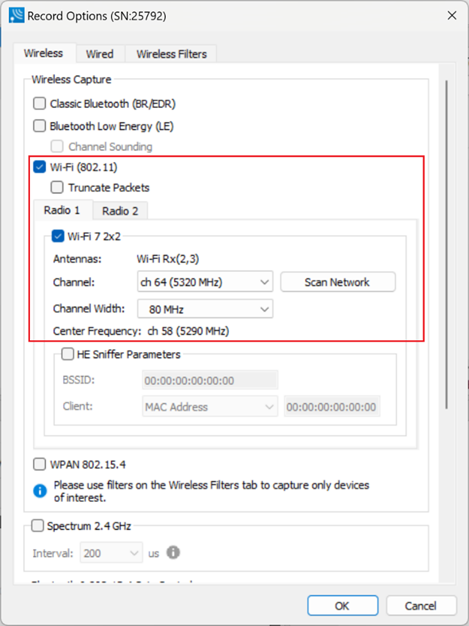
Radio 1 and Radio 2 tabs allow for configuration of two separate Wi-Fi chips. X500 supports Wi-Fi 5 4x4 on Radio 1 and Wi-Fi 6E 2x2 on Radio 2. X500e/X700 supports Wi-Fi 7 2x2 on both Radio 1 and Radio 2. The Channel and Channel Width can be configured for the appropriate settings for the Wi-Fi Standard supported.
When capturing Wi-Fi 5 using Frontline X500 hardware, it takes about 10 secs before new packets show up during the first recording session. Subsequent captures will be faster.
There is no delay when capturing Wi-Fi 6/6e.
X500/X500e/X700 Wi-Fi 5 4x4 Option Selections
|
Section |
Description |
|
Channel |
Select from the 2.4 GHz, 5 GHz, or 6 GHz primary channels. The primary channels are 20 MHz wide. They are used for signaling and backwards compatibility. The 6 GHz channels are only available with the Wi-Fi 6E/Wi-Fi 7 standard selection. |
|
Channel Width |
The possible Channel Width options are enabled based on the Primary Channel selection. For a 2.4 GHz channel, the possible options are 20 MHz, +40 MHz (expanded above the primary channel For a 5 GHz channel with the Wi-Fi 5 Standard, the possible options are 20 MHz, 40 MHz, 80 MHz. For a 5 or 6 GHz channel, with the Wi-Fi 6E Standard, the possible options are 20 MHz, 40 MHz, 80 MHz, and 160 MHz. For a 5 or 6 GHz channel, with the Wi-Fi 7 Standard, the possible options are 20MHz, 40MHz, 80 MHz, 160 MHz, and 320Mhz. |
|
Center Frequency |
This is the center frequency, automatically calculated from the Channel and the Channel Width selections. |
|
Truncate Packets |
When checked, the system truncates Wi-Fi data packets. The system does not truncate management or control type packets. In summary view, a user will only see the decoding for the Radio Tap and MAC header of truncated packets. This allows for smaller capture files. |
For Wi-Fi 6E/Wi-Fi 7
For Wi-Fi 6E/Wi-Fi7, you can specify additional parameters for capturing OFDMA packets associated with one device. OFDMA is a Wi-6E/Wi-Fi7 feature that allows subdividing the wireless channel bandwidth. This allows multiple clients to use the channel at the same time. The settings identify these additional parameters as HE Sniffer parameters.
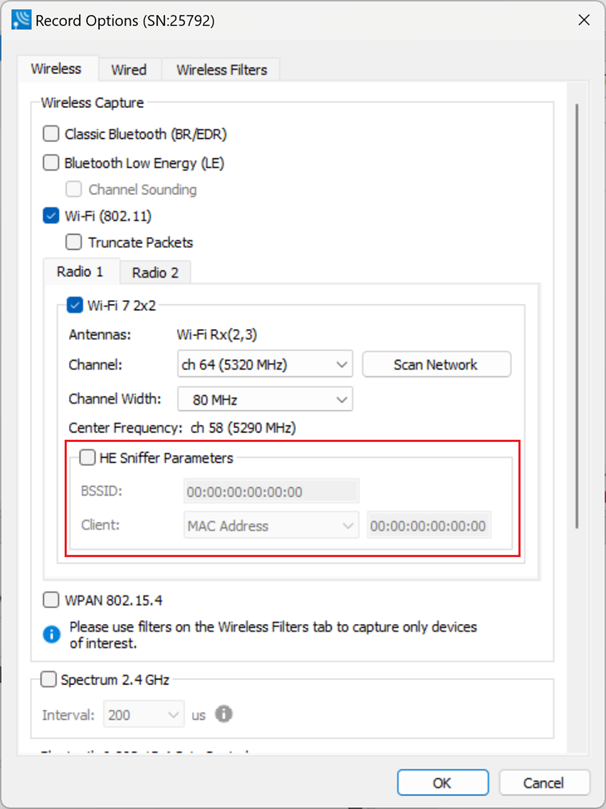
HE Sniffer Parameters
|
Section |
Description |
|
HE Sniffer Parameters |
This enables capturing OFDMA packets from one client device that’s associated to a BSSID. When this is enabled, the system can capture Wi-Fi 6 packets that have physical types of HE_ MU and HE_TRIG. |
|
BSSID |
This is the address of the access point in the connection. |
|
Client |
This indicates if the client is identified with its association ID or its MAC address. |
|
Client MAC Address |
This is the MAC address of the client. When a user specifies this parameter, the system extracts the association ID from an association response packet. After capturing the association response packet, the system will capture the OFDMA packets for this device. |
|
Client Association ID |
This is the association ID of the client. If a client device is already connected to an access point and the client’s association ID is known, then use this configuration option. |
For optimal Wi-Fi data capture, it is recommended to turn off beamforming in the devices under test.
Wireless Filters Tab
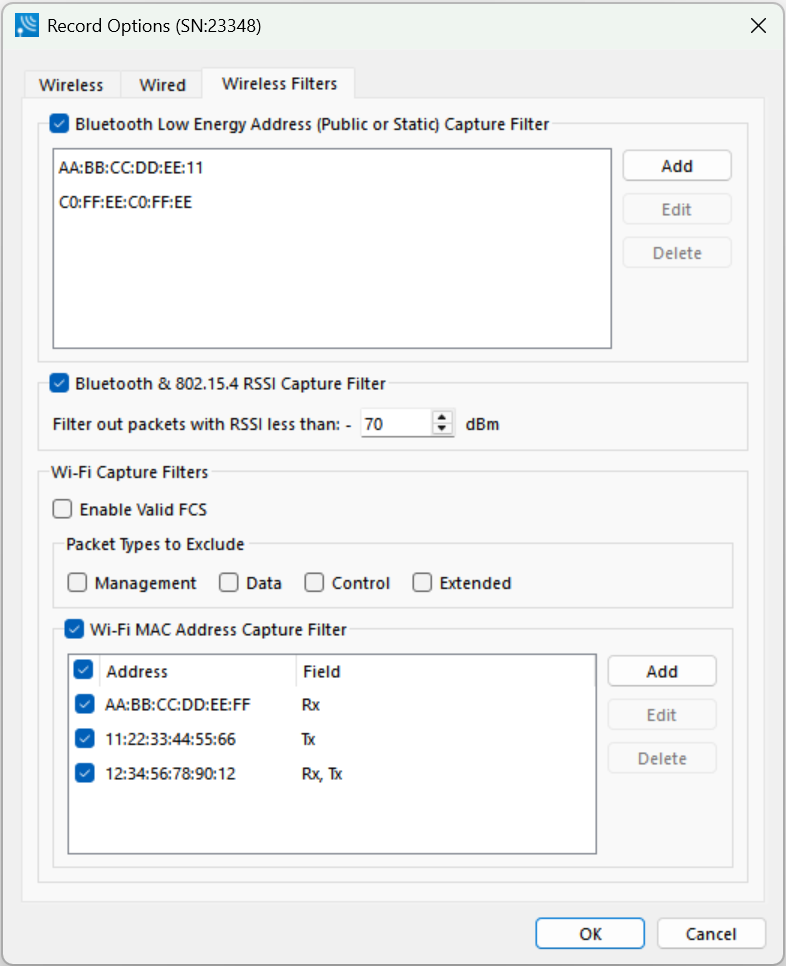
Record Options Wireless Filters Selections
|
Section |
Description |
|
Bluetooth Low Energy Address Capture Filter |
By enabling the Bluetooth Low Energy Address Capture Filter, only Low Energy packets from the listed Bluetooth Addresses will be processed into the capture. Addresses can be added, selected and edited, and selected and deleted by using the Add, Edit, Delete buttons respectively. |
|
|
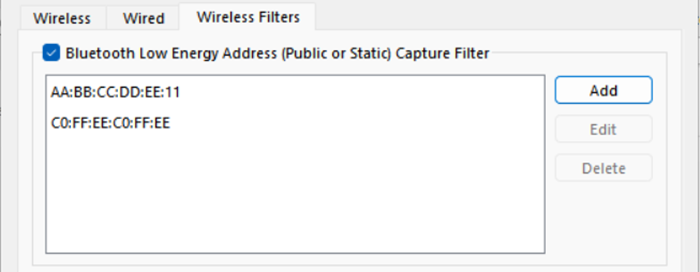
This filter can be useful in a crowded Bluetooth environment.
Advertising devices that aren't listed in the Bluetooth Low Energy Address Capture Filter will still show up in the Bluetooth Device Database. This way, if a device in the capture filter connects to an advertiser, the previous packets for context are available. |
|
RSSI Capture Filter |
By enabling the RSSI Capture Filter, only those packets with RSSI greater than the entered dBm value will be processed into the capture. 
This filter can be useful in a crowded Bluetooth environment. (RSSI is measured at the beginning of the packet and that same value is retained for the entire duration of the packet. Once the packet transmission ends, the RSSI value is reset.) |
|
Wi-Fi Capture Filters |
|
|
Enable Valid FCS |
When checked, the system only captures Wi-Fi packets with a valid checksum. This allows a user to filter out bad packets. |
|
Packet Types to Exclude |
When a type is checked, the system does not capture this type of Wi-Fi packet. This allows a user to filter out unnecessary packet types. For example, a user may only want to see Management type packets. |
|
Wi-Fi MAC Address Capture Filter |
See Wi-Fi MAC Address Filtering following this table. |
Wi-Fi MAC Address Filtering
In environments where many Wi-Fi signals can make it hard to focus analysis on only a few signals of interest, the Wi-Fi MAC Address Capture Filter options allow configuration of only the signals of interest.
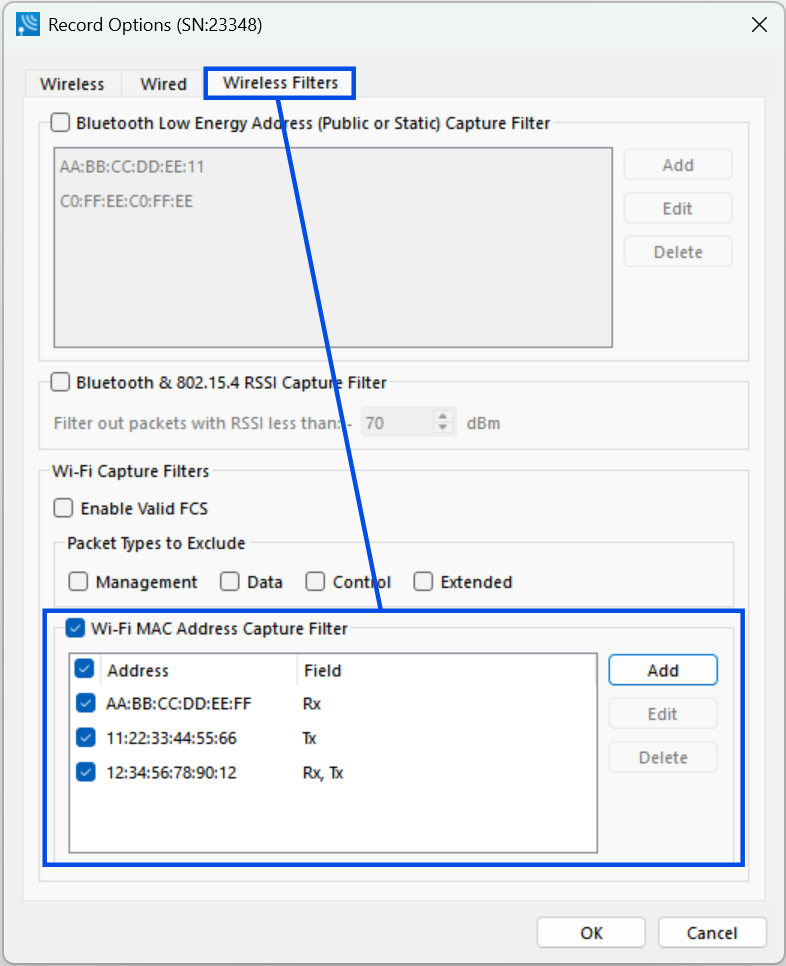
Wi-Fi Tab MAC Address Filtering
|
Setting |
Description |
|
Wi-Fi MAC Address Capture Filters |
This must be checked to enable the filtering of MAC Addresses on the X500/X500e. Unchecking this disables MAC Address filtering on the X500/X500e, allowing all Wi-Fi signals captured into WPS for analysis. |
|
Add |
Displays a dialog in which the MAC Address can be entered and controls for selecting TX/RX. See Wi-Fi MAC Address Editing following this table. |
|
Edit |
After selecting one of the MAC Addresses in the table, this will display a dialog in which the MAC Address and the TX/RX can be changed. See Wi-Fi MAC Address Editing following this table. |
|
Delete |
After selecting one of the MAC Addresses in the table, this will delete that MAC Address filter. |
Wi-Fi MAC Address Editing
The MAC Address table displays the MAC Address and the Fields which indicates whether the MAC Address is filtered by the Rx (Receive) and/or Tx (Transmit) Field in the MAC Frame.
There is an Enable checkbox for each MAC Address so that each one can be enabled or disabled for filtering. Up to eight MAC Addresses can be entered for filtering.
To add a MAC Address, click the Add button. The New Address dialog is displayed.
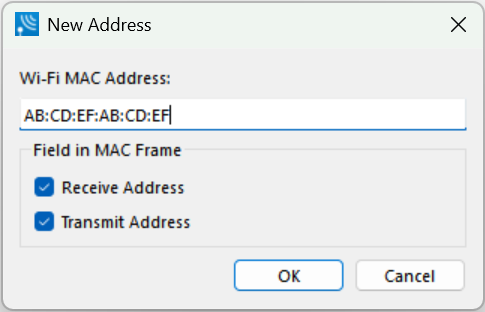
Enter the MAC Address into the edit field as indicated and select whether to filter that address as Receive and/or Transmit. Click OK and the MAC Address will appear in the MAC Address table with its Enable checkbox checked by default.
To edit a MAC Address, click on one of the MAC Addresses in the table to select it and click the Edit button. The same New Address dialog as above will display with all the information from the table already entered. Edit then click OK. The changes to the MAC Address appear in the MAC Address table.
If the Wi-Fi MAC Address Capture Filter checkbox is turned off, the MAC Address filters themselves are still retained on the analyzer for re-enabling later.
Record Options Dialog: X240
The Record Options dialog is used to configure the X240 unit prior to data capture. The record options are stored on the X240 hardware and these settings will persist until changed. The Record Options dialog is only active when a X240 unit is connected to the computer running the Wireless Protocol Suite software.
If a X240 hardware unit is not connected then these settings can neither be viewed nor changed.
Clicking on OK will save the Record Options settings on the connected X240 unit. Any Record Options parameter changes made will overwrite the previously saved Record Options.