
The following information applies when operating the analyzer in Spy mode or Source DTE, No FTS Cables mode. When using the cables supplied with the analyzer to capture or source data, Ring Indicator (RI) is routed to a different pin which generates interrupts normally.
There is a special case involving Ring Indicator and computers with 8250 UARTs or UARTs from that family where the state of RI may not be captured accurately. Normally when a control signal changes state from high to low or low to high, an interrupt is generated by the UART, and the analyzer goes to see what has changed and record it. Ring Indicator works a little differently. An interrupt is generated when RI changes from high to low, but not when RI changes from low to high. If Ring Indicator changes from low to high, the analyzer does not know that RI has changed state until another event occurs that generates an interrupt. This is simply the way the UART works and is not a deficiency in the analyzer software.
To minimize the chance of missing a Ring Indicator change, the analyzer polls the UART every millisecond to see if RI has changed. It is still possible for the analyzer to miss a Ring Indicator change if RI and only RI changes state more than once per millisecond.
UARTs in the 8250 family include 8250s, 16450s, 16550s and 16550 variants. If you have any questions about the behavior of your UART and Ring Indicator, please contact technical support.
Useful Character Tables
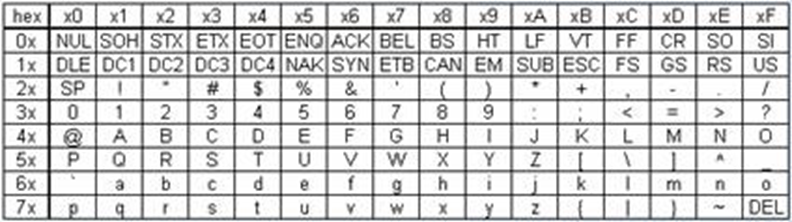
ASCII Codes
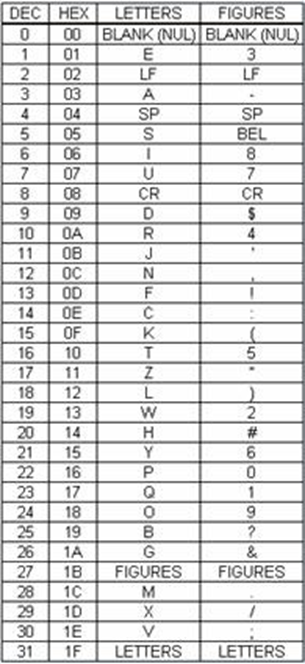
Baudot Codes
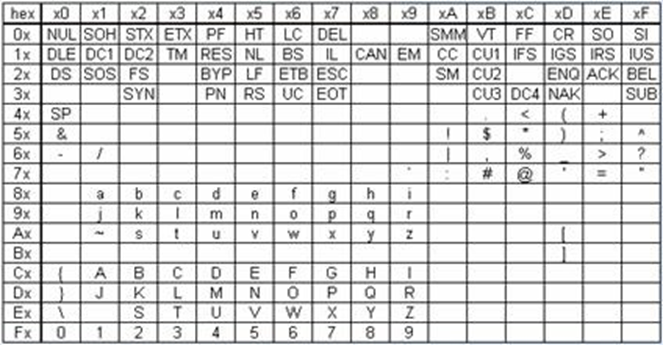
EBCDIC Codes
Communication Control Characters
Listed below, in alphabetical order, are the expanded text meanings for common ANSI communication control characters, and the two-character system abbreviation for each one. Some abbreviations have forward slash characters between the two letters. This is to differentiate the abbreviations for a control character from a hex number. For example, the abbreviation for Form Feed is listed as F/F, to differentiate it from the hex number FF.
Communications Control Characters
|
Abbreviation |
Control Character |
Text |
|
AK |
ACK |
Acknowledge |
|
BL |
BEL |
Bell |
|
BS |
BS |
Backspace |
|
CN |
CAN |
Cancel |
|
CR |
CR |
Carriage Return |
|
D/1-4 |
DC1-4 |
Device Control 1-4 |
|
D/E |
DEL |
Delete |
|
DL |
DLE |
Data Link Escape |
|
EM |
EM |
End of Medium |
|
EQ |
ENQ |
Enquiry |
|
ET |
EOT |
End of Transmission |
|
E/C |
ESC |
Escape |
|
E/B |
ETB |
End of Transmission Block |
|
EX |
ETX |
End of Text |
|
F/F |
FF |
Form Feed |
|
FS |
FS |
File Separator |
|
GS |
GS |
Group Separator |
|
HT |
HT |
Horizontal Tabulation |
|
LF |
LF |
Line Feed |
|
NK |
NAK |
Negative Acknowledge |
|
NU |
NUL |
Null |
|
RS |
RS |
Record Separator |
|
SI |
SI |
Shift In |
|
SO |
SO |
Shift Out |
|
SH |
SOH |
Start of Heading |
|
SX |
STX |
Start of Text |
|
SB |
SUB |
Substitute |
|
SY |
SYN |
Synchronous Idle |
|
US |
US |
Unit Separator |
|
VT |
VT |
Vertical Tabulation |